Food and Nutrition Basics: A Simple Guide to Eating Well
Eating well does not require perfect willpower or a complicated diet plan. For most people, it comes down to learning a few food and nutrition basics (what your body needs, what "balanced" looks like, and how to stay consistent). Once you have those fundamentals, everything from meal prep to restaurant choices becomes easier.
This guide breaks down the essentials in plain English, with practical examples you can use today.
What "eating well" actually means
Eating well is not one universal menu. It is a pattern that:
- Helps you meet your nutrient needs most days (protein, fiber, vitamins, minerals, essential fats)
- Supports your goals (energy, strength, weight change, endurance, better labs)
- Fits your life (budget, culture, schedule, preferences)
- Is sustainable (you can keep doing it)
A useful north star is to prioritize nutrient density (more nutrients per calorie) while still enjoying foods you love. Guidance like the USDA's MyPlate and Harvard's Healthy Eating Plate can help you visualize what that pattern looks like.
The building blocks: macros, micros, fiber, and water
Macronutrients (macros)
Macros are the nutrients your body needs in larger amounts: protein, carbohydrates, and fat. They provide energy (calories) and also do specific jobs, like building muscle or supporting hormones.
| Macro | What it does | Common high-quality sources | Practical tip |
|---|---|---|---|
| Protein | Builds and repairs tissues, supports muscle, helps with fullness | Fish, poultry, eggs, Greek yogurt, tofu, tempeh, beans, lentils | Include a protein at every meal to make eating patterns easier to sustain. |
| Carbs | Main fuel for your brain and training, provides fiber (when from plants) | Fruit, oats, potatoes, beans, whole grains | Prefer minimally processed carbs most of the time, especially around active days. |
| Fat | Helps absorb vitamins (A, D, E, K), supports hormones and satiety | Olive oil, nuts, seeds, avocado, fatty fish | Add a "thumb-sized" fat to meals that are very lean to improve satisfaction. |
How much protein do you need? Needs vary by body size, activity level, age, and goals. The general Recommended Dietary Allowance (RDA) is 0.8 g/kg/day for adults, but many active people do well with higher intakes. If you are training regularly or aiming to preserve muscle while losing weight, consider discussing a target with a qualified professional.
Micronutrients (vitamins and minerals)
Micronutrients do not provide calories, but they are essential for performance, recovery, immunity, bone health, and more.
Instead of obsessing over single vitamins, focus on diet variety, because different foods "cover" different micronutrients.
- Colorful produce supports nutrients like vitamin C, folate, potassium, and many phytonutrients.
- Dairy or fortified alternatives can support calcium and vitamin D.
- Seafood can provide iodine and omega-3 fats.
- Beans, leafy greens, and fortified grains can contribute iron and folate.
If you have symptoms, dietary restrictions (vegan, dairy-free), heavy training, or a medical condition, labs and individualized advice can be worthwhile.
Fiber
Fiber supports gut health and helps with fullness, blood sugar stability, and cholesterol. Many people under-consume it.
Simple ways to raise fiber without overhauling your diet:
- Choose one higher-fiber carb daily (oats, beans, lentils, whole grains, berries)
- Add a vegetable to one meal you usually skip veggies at (often breakfast or lunch)
- Include a "plant booster" like chia, ground flax, or beans a few times per week
For general guidance on fiber and healthy patterns, see the Dietary Guidelines for Americans.
Water (and hydration)
Hydration affects energy, training quality, digestion, and appetite cues. Needs vary widely based on sweat rate, climate, and body size.
A simple rule: aim for pale yellow urine most of the day, drink with meals, and add extra fluids when you sweat. For endurance training or heavy sweat, electrolytes can be useful.
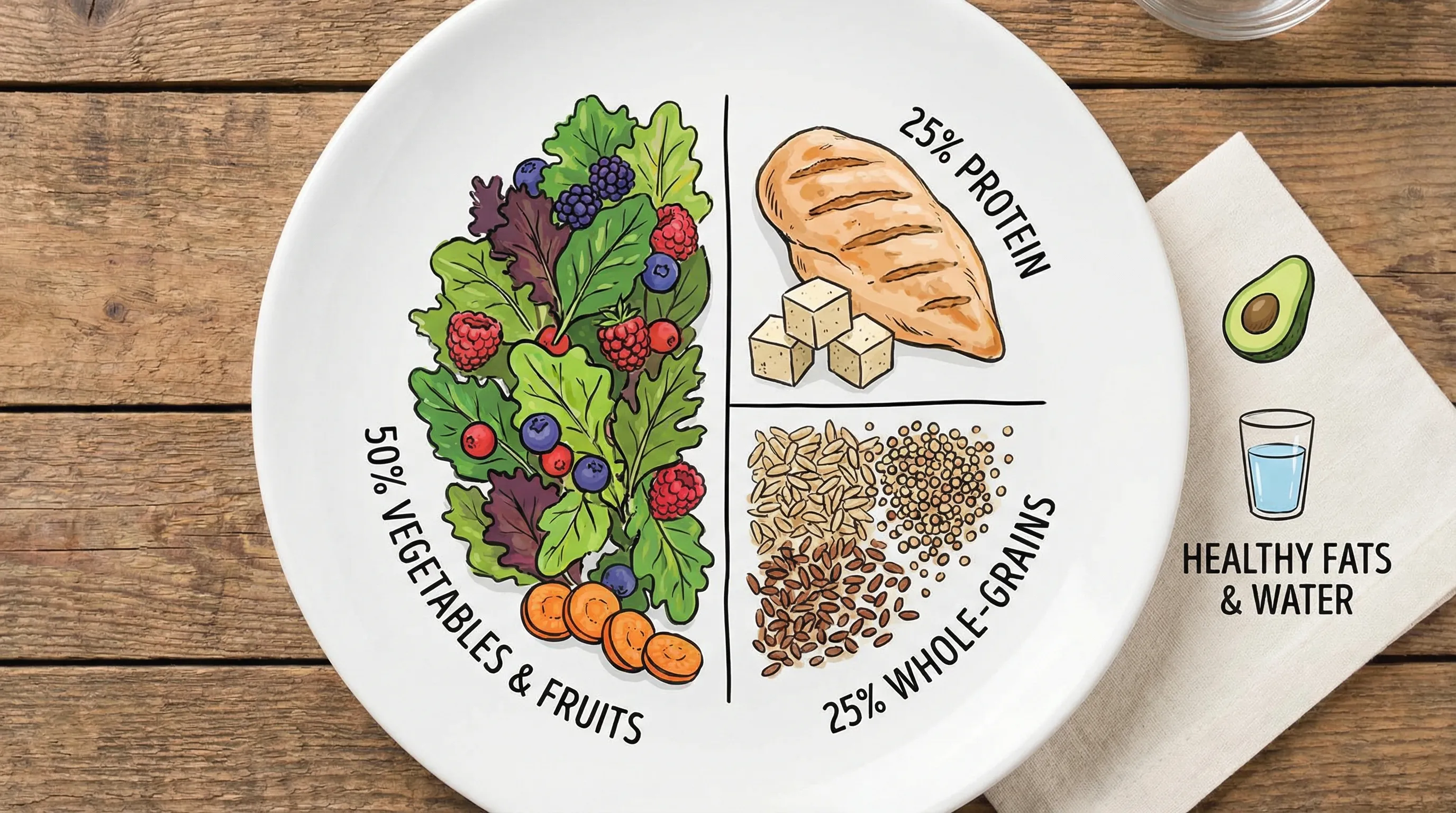
The simplest visual: build a balanced plate
When in doubt, use a plate method. It reduces decision fatigue and naturally improves macro balance and micronutrient intake.
A practical template:
- Half the plate: non-starchy vegetables and fruit
- One quarter: protein
- One quarter: high-quality carbs (whole grains, starchy vegetables, beans)
- Add: a small amount of healthy fat (olive oil, avocado, nuts)
Examples you can copy
- Breakfast: Greek yogurt + berries + oats + walnuts
- Lunch: Turkey (or tofu) salad bowl + quinoa + olive oil vinaigrette
- Dinner: Salmon + roasted vegetables + potatoes + side fruit
If you eat mixed dishes (tacos, stir-fries, pasta), the same logic applies. Mentally estimate: "Did I get produce, protein, and a quality carb?"
Food quality: what to prioritize within each group
You do not need perfection. You do need a few priorities that pay off quickly.
Protein: aim for consistency
Protein is often the "anchor" of a meal because it supports fullness and muscle maintenance.
Good options include:
- Lean meats and poultry
- Fish (including fatty fish like salmon or sardines)
- Eggs
- Dairy (milk, skyr, cottage cheese, Greek yogurt) or fortified alternatives
- Legumes (beans, lentils)
- Soy foods (tofu, tempeh, edamame)
If you struggle with afternoon cravings, try increasing protein earlier in the day.
Carbs: choose the form that matches your goals
Carbs are not "good" or "bad." Their impact depends on type, portion, and timing.
- For general health and weight management: emphasize whole, high-fiber carbs (beans, oats, fruit, potatoes, whole grains).
- For hard training days: include more carbs around workouts to support performance.
- For blood sugar concerns: pairing carbs with protein, fiber, and fat often improves post-meal responses, but follow medical guidance if you have diabetes or prediabetes.
Fats: focus on unsaturated fats most of the time
Unsaturated fats (olive oil, nuts, seeds, avocado, fatty fish) support heart health. Many guidelines recommend limiting saturated fat and keeping trans fat as low as possible. For general heart-health guidance, see the American Heart Association.
Portion basics (without counting everything)
Calories still matter for weight change, but most people do not want to track every bite forever. Portion awareness can be enough.
A simple hand guide (scaled to your body):
| Food | Rough portion guide | Notes |
|---|---|---|
| Protein | 1 to 2 palms per meal | Adjust up for strength training goals. |
| Carbs | 1 to 2 cupped hands per meal | Adjust up for endurance or intense training. |
| Fats | 1 to 2 thumbs per meal | Easy to overdo, since fats are energy-dense. |
| Vegetables | 1 to 2 fists per meal | Often beneficial to increase. |
Use this as a starting point, then adjust based on hunger, energy, training, and results.
How to read a nutrition label (quickly)
Nutrition labels can be confusing, but you only need a few checks most of the time.
1) Start with serving size
Many "healthy" foods look great until you notice the serving size is half the package.
2) Look for protein and fiber
These two often predict how filling a food will be.
3) Watch added sugar and sodium
Many guidelines suggest keeping added sugars and sodium within reasonable limits (for many adults, sodium is commonly recommended to stay under 2,300 mg/day, but needs vary). If you are managing blood pressure or other conditions, follow clinical advice.
For label definitions, the FDA has a clear overview of How to Understand and Use the Nutrition Facts Label.
4) Check the ingredient list for "ultra-processed" patterns
You do not need to fear ingredients you cannot pronounce, but ingredient lists can reveal when a food is mostly refined starch, added oils, and added sweeteners.
A helpful mindset: the more your daily eating pattern is built on minimally processed staples (fruit, vegetables, grains, beans, meats, dairy, nuts), the easier it becomes to hit nutrition targets.
Timing and consistency: the underrated basics
If your schedule is chaotic, "perfect macros" do not matter as much as consistency.
Two habits that often improve results quickly:
- Eat a real breakfast (or first meal) with protein and fiber. This can reduce later snacking for many people.
- Plan one reliable meal. For example, a repeatable lunch you can make in 10 minutes.
If you train, a simple approach is:
- Pre-workout: carbs plus a bit of protein (if you have time)
- Post-workout: protein plus carbs (especially after longer or harder sessions)
You do not need special supplements for this, normal food works.
Common food and nutrition misconceptions (and what to do instead)
"Healthy eating means cutting carbs."
Many people feel better initially when they reduce highly refined carbs (sugary snacks, pastries, soda). That does not mean all carbs are the problem. Try swapping in high-fiber options and adjusting portions.
"If I eat fat, I get fat."
Body fat gain is driven by sustained calorie surplus, not a single macro. Dietary fat is essential, it is just easier to over-consume because it is calorie-dense. Use measured portions, not avoidance.
"I should eat perfectly clean."
All-or-nothing thinking is one of the fastest routes to burnout. Aim for a strong foundation, then include flexibility. A consistent pattern beats a perfect week followed by quitting.
A simple way to improve fast: track awareness, not perfection
Many people struggle because they are guessing. "I think I eat enough protein," or "I barely eat sugar," is hard to validate without feedback.
If traditional tracking feels tedious, photo-based logging can be a practical middle ground: you capture what you ate, get an estimate of calories and macros, and you can spot patterns over time.
Vitality is built for this kind of low-friction consistency. With photo-based meal tracking and AI-powered nutrition analysis, you can monitor macros and micronutrients, and connect your intake with workouts, vitals, and trends, without manually searching every ingredient. Because it is designed with a privacy-first approach, you can focus on learning from your data rather than sharing it.

Frequently Asked Questions
What are the most important food and nutrition basics for beginners? Focus on a balanced plate (produce, protein, quality carbs, healthy fats), consistent protein, more fiber, and hydration. Keep it simple and repeatable.
Do I need to count calories to eat well? Not always. Many people do well with portion awareness, higher protein and fiber, and a consistent meal structure. Calorie tracking can help for specific goals, but it is not required for everyone.
What should I eat if I want more energy during the day? Prioritize a protein-rich first meal, add fiber-rich carbs (fruit, oats, beans, whole grains), stay hydrated, and avoid long gaps that lead to overeating later.
How can I improve my diet if I have a busy schedule? Pick one repeatable breakfast and one repeatable lunch, keep high-protein staples available (Greek yogurt, eggs, tofu, canned fish, beans), and use frozen vegetables and microwavable grains to save time.
Is photo-based food tracking accurate? It is typically an estimate, especially for mixed meals and restaurant portions. It is still highly useful for spotting patterns and improving consistency, which is what drives results for most people.
Turn the basics into a routine with Vitality
Knowing the fundamentals is the first step. The next step is consistency, and that is where most people get stuck.
If you want an easier way to apply these food and nutrition basics day-to-day, try Vitality. Snap a photo to log meals, review macro and micronutrient breakdowns, and track how your nutrition lines up with workouts, vitals, and progress over time.