Indian Calorie Deficit Diet Chart: 1,500 and 1,800 kcal, Veg and Non-Veg
19 min read
You want to lose weight on the food you already cook: roti, dal, sabzi, rice and curd. What you need is one day written out in rotis, katoris and teaspoons, with numbers you can check and change.
A calorie deficit means eating fewer calories than your body uses. 1,500 and 1,800 kcal are two common levels, not targets for everyone. By ICMR-NIN's 2020 figures, a sedentary 55 kg woman needs about 1,660 kcal a day and a sedentary 65 kg man 2,110, so 1,500 kcal is a small deficit for her and 1,800 kcal is none, while for him they are deficits of about 610 and 310 kcal. The four day charts below total 1,510 to 1,519 kcal and 1,805 to 1,810 kcal, with 56 to 78 g of protein, calculated from the Indian Food Composition Tables 2017 with every teaspoon of oil counted (checked 12 November 2026). Work out your own maintenance first.
This post covers who each level suits, how to find your number, who needs a doctor or dietitian first, the four charts, swaps and where home charts go wrong.
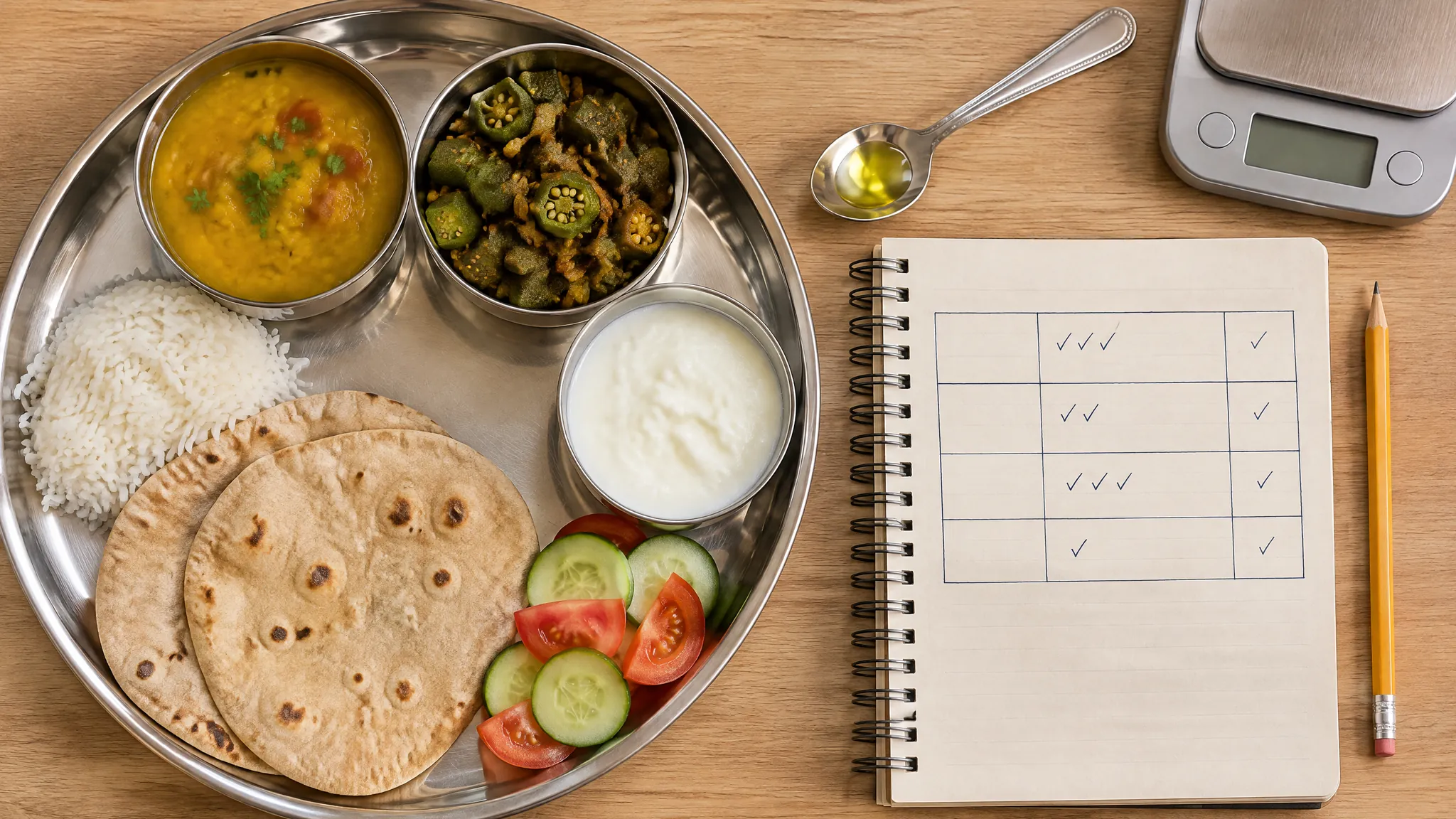
What is a calorie deficit, and who do 1,500 and 1,800 kcal suit?
Maintenance is the number of calories a day at which your weight holds steady. Eat below it and your body covers the gap from its stores. The same chart is therefore a large deficit for one person and none for another.
ICMR-NIN, India's National Institute of Nutrition, publishes energy needs for reference adults (2020 requirements, read on 12 November 2026). The last two columns are our subtraction:
| ICMR-NIN reference adult | Energy need a day | A 1,500 kcal chart is | An 1,800 kcal chart is |
|---|---|---|---|
| Woman, 55 kg, sedentary work | 1,660 kcal | 160 kcal below (10%) | 140 kcal above: no deficit |
| Woman, 55 kg, moderate work | 2,130 kcal | 630 kcal below (30%) | 330 kcal below (15%) |
| Man, 65 kg, sedentary work | 2,110 kcal | 610 kcal below (29%) | 310 kcal below (15%) |
| Man, 65 kg, moderate work | 2,710 kcal | 1,210 kcal below (45%) | 910 kcal below (34%) |
So 1,500 kcal roughly suits a sedentary man or a moderately active woman near those weights, and 1,800 kcal gives the same two people a gentler deficit. For the sedentary woman, 1,500 kcal is only a 160 kcal deficit and 1,800 kcal is above her needs. For the moderately active man both are steep: 1,500 kcal is a 45% cut, past ICMR-NIN's limit (below).
Heavier people need more than these reference figures: ICMR-NIN says requirements "should be adjusted for the actual weight and physical activity". So estimate your own.
How to calculate your calorie deficit
1. Estimate your maintenance calories
The Mifflin-St Jeor equation estimates basal metabolic rate (BMR), the energy you use at rest:
- Men: BMR = (10 × weight in kg) + (6.25 × height in cm) − (5 × age) + 5
- Women: BMR = (10 × weight in kg) + (6.25 × height in cm) − (5 × age) − 161
Multiply by an activity factor: 1.2 if sedentary, 1.375 lightly active, 1.55 moderately active, 1.725 very active, 1.9 extra active. This is the equation in its usual rounded form, with the multipliers that VitalityApp, which publishes this blog, lists for its fallback estimate.
Worked example. A 35-year-old man, 80 kg and 172 cm: BMR = 800 + 1,075 − 175 + 5 = 1,705 kcal. Sedentary, he maintains on 1,705 × 1.2 = 2,046 kcal. Lightly active, on 1,705 × 1.375 = 2,344 kcal.
It is only an estimate. In a 2020 study of 125 women, Mifflin-St Jeor was the most accurate of five equations, yet came within 10% of measured resting metabolic rate for only 71% of them. Check yours against your weekly weight trend over two to three weeks.
2. Choose the deficit
ICMR-NIN's 2024 Dietary Guidelines for Indians describes typical weight-loss diets as a "500–750 Kcal/day deficit", with two limits:
- "it is advisable not to go beyond 40% energy deficit of daily energy needs"
- "Weight reduction diets should not be less than 1000 Kcal/day and should provide all nutrients."
US guidance is similar. The 2013 obesity guideline from the American Heart Association and two partner societies tells clinicians to prescribe "1200–1500 kcal/d for women and 1500–1800 kcal/d for men", or a deficit of 500 or 750 kcal a day, and keeps diets under 800 kcal a day for medical settings.
For the man in the example, a 1,500 kcal chart is a deficit of about 530 kcal if he is sedentary (26% of his needs). If he is lightly active, an 1,800 kcal chart leaves about the same gap.
3. Expect slower loss than the sum says
ICMR-NIN's line is: "A reduction of half a kilogram body weight per week is considered to be safe." The usual sum treats a kilogram of body weight as about 7,700 kcal (the 3,500 kcal per pound rule), so half a kilo a week needs a deficit of about 550 kcal a day.
That sum overstates what happens. In The Lancet in 2011, Kevin Hall and colleagues wrote that the rule "ignores dynamic physiological adaptations to altered body weight": a lighter body burns less, so the same chart becomes a smaller deficit. In their model, a 100 kg sedentary man who cuts 480 kcal a day ends up about 25 kg lighter, but takes roughly a year to lose the first half. The 7,700 kcal rule would have him 22.8 kg down in that year. The model says about 12.5 kg. No chart can tell you how much you will lose.
Who should not follow a diet chart without a doctor or dietitian
These charts are general wellness information for healthy adults. See a doctor or registered dietitian first if:
- You are pregnant or breastfeeding. ICMR-NIN adds 350 kcal a day in the second and third trimesters and 600 kcal in the first six months of breastfeeding.
- You are under 18. ICMR-NIN puts energy needs at 2,060 to 3,320 kcal a day from 10 to 18 years, above both charts.
- You have, or have had, an eating disorder.
- You have diabetes, heart disease, kidney disease or another condition with its own diet. ICMR-NIN says of its own "My Plate" pattern: "The meal plan is not for any specific medical condition". The US guideline recommends referral to a nutrition professional when a specialised diet is prescribed. With kidney disease, ICMR-NIN says high-protein diets "should be taken with care".
- Your deficit would take you below about 1,200 kcal (women) or 1,500 kcal (men), the bottom of the US ranges, or below ICMR-NIN's 1,000 kcal floor.
ICMR-NIN's 2011 manual went further: "All reducing regimens should be monitored by a doctor and a dietitian." The 2024 edition does not repeat that sentence. Nothing in this post is medical advice: see the medical disclaimer.
How these charts are built
These charts are this blog's arithmetic, not ICMR-NIN's charts and not a dietitian's plan for you. Each row is grams multiplied by the food's value per 100 g in IFCT 2017, ICMR-NIN's food tables, which list ingredients, not dishes. Kilojoules are divided by 4.184. Rows are rounded, and each total is the sum of its rows. We added up energy and protein only, not vitamins and minerals.
- Katori: 200 ml, the size in ICMR-NIN's diet charts. Its standard katoris run from 115 to 360 ml, so measure yours.
- Roti: a medium roti is 30 g of atta, no ghee: 96 kcal and 3.2 g protein. The size is a kitchen approximation (ICMR-NIN's 2011 figure of 80 kcal for a phulka works out at about 25 g), so weigh the atta for one of yours.
- Rice: a katori of cooked rice is 50 g raw: 178 kcal and 4.0 g protein.
- Dal: a katori is 30 g of raw toor dal: 99 kcal and 6.5 g protein, before the tadka. A thick dal has more: ICMR-NIN's 2011 menus put 20 g of raw dal in half a cup.
- Oil and ghee: a teaspoon is 5 g and 45 kcal, ICMR-NIN's measure. Each chart counts 4 teaspoons (20 g) for the day's cooking on its own row. That is ICMR-NIN's limit for a sedentary woman (30 g for a sedentary man) and about a teaspoon per cooked dish, a kitchen approximation.
- Curd: IFCT has no entry, so curd is counted as the whole cow's milk it is set from (73 kcal and 3.3 g protein per 100 g), a kitchen approximation.
- Chai: a 150 ml cup with 75 ml of whole cow's milk (counted as 75 g) and 1 teaspoon of sugar, at ICMR-NIN's 20 kcal a teaspoon.
- Eggs: 50 g each, at IFCT's boiled-egg value (74 kcal, 6.7 g protein).
- Poha and upma: 50 g dry makes about one katori cooked, going by ICMR-NIN's 2011 menus.
- Everything else is weighed raw, chicken and fish without bone. By ICMR-NIN's measures, 100 g of chopped vegetables or fruit fills a katori. Paneer, rajma, fish and chicken have no published household measure, so weigh them once. Spices and salt are not counted.
1,500 kcal Indian diet chart
Vegetarian: 1,519 kcal, 55.9 g protein
| Meal | Food and portion | kcal | Protein (g) |
|---|---|---|---|
| Breakfast | Poha (50 g dry poha, 30 g onion, 15 g groundnuts) | 269 | 7.7 |
| Curd, ½ katori (100 g) | 73 | 3.3 | |
| Lunch | 2 medium rotis (60 g atta) | 192 | 6.3 |
| Toor dal, 1 katori (30 g raw) | 99 | 6.5 | |
| Bhindi sabzi (100 g bhindi, 30 g onion) | 42 | 2.5 | |
| Curd, ½ katori (100 g) | 73 | 3.3 | |
| Salad (50 g cucumber, 50 g tomato) | 18 | 0.8 | |
| Evening | Moong sprouts (30 g dry whole moong) | 88 | 6.8 |
| Guava, 100 g (1 katori chopped) | 32 | 1.4 | |
| Dinner | Rice, 1 katori (50 g raw) | 178 | 4.0 |
| Moong dal, 1 katori (30 g raw) | 98 | 7.2 | |
| Lauki sabzi (150 g lauki, 25 g tomato, 15 g onion) | 28 | 1.2 | |
| Any time | Chai, 2 cups (150 ml milk, 2 tsp sugar) | 149 | 4.9 |
| All day | Oil or ghee for cooking, 4 tsp (20 g) | 180 | 0 |
| Total | 1,519 | 55.9 |
Non-vegetarian: 1,510 kcal, 71.5 g protein
| Meal | Food and portion | kcal | Protein (g) |
|---|---|---|---|
| Breakfast | Egg bhurji (2 eggs, 30 g onion, 30 g tomato) | 168 | 14.1 |
| 2 medium rotis (60 g atta) | 192 | 6.3 | |
| Lunch | Rice, 1 katori (50 g raw) | 178 | 4.0 |
| Fish curry (100 g raw rohu, 40 g onion, 40 g tomato) | 129 | 20.6 | |
| Cabbage sabzi (100 g cabbage, 25 g fresh peas) | 42 | 3.2 | |
| Curd, ½ katori (100 g) | 73 | 3.3 | |
| Evening | Apple, 100 g (1 katori chopped) | 62 | 0.3 |
| Dinner | 2 medium rotis (60 g atta) | 192 | 6.3 |
| Toor dal, 1 katori (30 g raw) | 99 | 6.5 | |
| Lauki sabzi (150 g lauki, 25 g tomato, 15 g onion) | 28 | 1.2 | |
| Salad (50 g cucumber, 50 g tomato) | 18 | 0.8 | |
| Any time | Chai, 2 cups (150 ml milk, 2 tsp sugar) | 149 | 4.9 |
| All day | Oil or ghee for cooking, 4 tsp (20 g) | 180 | 0 |
| Total | 1,510 | 71.5 |
Rohu is 102 kcal per 100 g raw in IFCT, and bangda (mackerel) is 101.
1,800 kcal Indian diet chart
Vegetarian: 1,805 kcal, 68.4 g protein
| Meal | Food and portion | kcal | Protein (g) |
|---|---|---|---|
| Breakfast | Upma (50 g suji, 30 g onion, 30 g carrot, 30 g fresh peas) | 216 | 8.6 |
| Curd, ½ katori (100 g) | 73 | 3.3 | |
| Orange, 100 g peeled | 37 | 0.7 | |
| Lunch | 2 medium rotis (60 g atta) | 192 | 6.3 |
| Rice, 1 katori (50 g raw) | 178 | 4.0 | |
| Rajma (40 g raw rajma, 30 g onion, 30 g tomato) | 140 | 8.6 | |
| Bhindi sabzi (100 g bhindi, 30 g onion) | 42 | 2.5 | |
| Curd, ½ katori (100 g) | 73 | 3.3 | |
| Salad (50 g cucumber, 50 g tomato) | 18 | 0.8 | |
| Evening | Chana chaat (30 g dry whole chana, 25 g onion, 25 g tomato) | 103 | 6.2 |
| Dinner | 2 medium rotis (60 g atta) | 192 | 6.3 |
| Palak paneer (50 g paneer, 100 g spinach, 25 g onion, 25 g tomato) | 194 | 12.1 | |
| Salad (50 g cucumber, 50 g tomato) | 18 | 0.8 | |
| Any time | Chai, 2 cups (150 ml milk, 2 tsp sugar) | 149 | 4.9 |
| All day | Oil or ghee for cooking, 4 tsp (20 g) | 180 | 0 |
| Total | 1,805 | 68.4 |
Non-vegetarian: 1,810 kcal, 77.8 g protein
| Meal | Food and portion | kcal | Protein (g) |
|---|---|---|---|
| Breakfast | Poha (50 g dry poha, 30 g onion) | 191 | 4.2 |
| 2 boiled eggs (100 g) | 148 | 13.4 | |
| Lunch | 2 medium rotis (60 g atta) | 192 | 6.3 |
| Rice, 1 katori (50 g raw) | 178 | 4.0 | |
| Chicken curry (100 g skinless breast, 40 g onion, 40 g tomato) | 195 | 22.7 | |
| Curd, ½ katori (100 g) | 73 | 3.3 | |
| Salad (50 g cucumber, 50 g tomato) | 18 | 0.8 | |
| Evening | Banana, 100 g peeled | 105 | 1.2 |
| Dinner | 2 medium rotis (60 g atta) | 192 | 6.3 |
| Toor dal, 1 katori (30 g raw) | 99 | 6.5 | |
| Aloo gobi (50 g potato, 100 g cauliflower, 25 g tomato, 20 g onion) | 72 | 3.4 | |
| Salad (50 g cucumber, 50 g tomato) | 18 | 0.8 | |
| Any time | Chai, 2 cups (150 ml milk, 2 tsp sugar) | 149 | 4.9 |
| All day | Oil or ghee for cooking, 4 tsp (20 g) | 180 | 0 |
| Total | 1,810 | 77.8 |
The chicken row is IFCT's skinless breast: 168 kcal and 21.8 g protein per 100 g. IFCT does not say whether that is raw or cooked meat, and USDA's raw skinless breast is 120 kcal per 100 g (checked 14 October 2026 for an earlier post), so the row may overstate the curry by up to about 50 kcal.
Across the four charts, cereals supply 36% to 41% of the energy and fat 27% to 29%, under ICMR-NIN's ceilings of 45% and 30%.
Indian food swaps at similar calories and protein
Rotate foods within a group and the day's total barely moves. Values are from IFCT 2017, before oil.
| Group | Food and portion | kcal | Protein (g) |
|---|---|---|---|
| Cereals | 2 medium rotis (60 g atta) | 192 | 6.3 |
| Rice, 1 katori (50 g raw) | 178 | 4.0 | |
| Poha, 50 g dry | 177 | 3.7 | |
| Suji for upma, 50 g | 167 | 5.7 | |
| 2 jowar rotis (60 g flour) | 200 | 6.0 | |
| 3 idlis (50 g parboiled rice, 20 g urad dal) | 241 | 8.5 | |
| Dal, 1 katori | Toor dal, 30 g raw | 99 | 6.5 |
| Moong dal, 30 g raw | 98 | 7.2 | |
| Rajma, 35 g raw | 105 | 7.0 | |
| Protein dish | 2 boiled eggs (100 g) | 148 | 13.4 |
| Paneer, 50 g | 153 | 9.4 | |
| Skinless chicken breast, 90 g | 151 | 19.6 | |
| Rohu, 150 g raw | 153 | 29.6 | |
| Snack | Groundnuts, 15 g (3 tsp) | 78 | 3.5 |
| Moong sprouts (30 g dry whole moong) | 88 | 6.8 | |
| 1 boiled egg (50 g) | 74 | 6.7 |
Vegetables per 100 g raw: lauki 11 kcal, cabbage 22, cauliflower 23, spinach 24, brinjal 25, bhindi 27, carrot 33. Potato (70) and fresh peas (81) are heavier.
The idli row is our estimate of the batter: ICMR-NIN's 2011 sample menu counts 3 idlis, 2 dosas or a cup of upma as the breakfast from 50 g of cereal and 20 g of pulses. Sambar and chutney are extra.
How to adjust a chart by 100 to 200 kcal
To go down, cut cereals, oil and sugar first, as ICMR-NIN advises: "For reducing weight, cut down on calorie from refined carbs and cooking oils". One roti less is 96 kcal, and half a katori of rice is 89. For about 180 kcal, drop a roti, a teaspoon of oil and both teaspoons of sugar (96 + 45 + 40 = 181). Keep the dal, curd, eggs and vegetables, and stay above the floors described earlier.
To go up, add a roti (96 kcal), a katori of dal (99) or 100 g of banana (105). A roti and a katori of dal add 195 kcal and 9.7 g of protein.
How to raise protein without supplements
ICMR-NIN's allowance is 0.83 g of protein per kg a day (about 54 g at 65 kg), and it says "15% energy from protein" may matter in a weight-loss diet: about 56 g at 1,500 kcal and 68 g at 1,800. To go higher at the same calories, swap by the table:
- A roti (96 kcal, 3.2 g) for a katori of dal (99 kcal, 6.5 g).
- 15 g of groundnuts (78 kcal, 3.5 g) for a boiled egg (74 kcal, 6.7 g) or moong sprouts (88 kcal, 6.8 g).
- If you eat fish, 50 g of paneer (153 kcal, 9.4 g) for 150 g of rohu (153 kcal, 29.6 g).
You do not need a powder. ICMR-NIN's protein guideline tells readers to "avoid protein supplements to build muscle mass", and states: "Protein powders are unnecessary for normal healthy life."
Where home diet charts go wrong
Oil and ghee. A thali of 2 rotis, dal, rice, bhindi sabzi, curd and salad is about 600 kcal before any fat. With 1 teaspoon of oil in total it is 645 kcal, with 3 teaspoons 735 and with 6 teaspoons 870: the same food, 225 kcal apart. The charts assume 20 g of oil a day. Urban Indians averaged 29.5 g of visible fat a day, and 45.9 g in the urban north, in the 2016 survey behind ICMR-NIN's What India Eats. That would add about 85 or 233 kcal a day to any chart here. Measure oil with a teaspoon. On ghee, ICMR-NIN says: "Limit ghee or butter to just 1 to 2 teaspoons/day or avoid, if possible."
Sugar in chai. The charts allow 1 teaspoon a cup, twice a day: 40 kcal. Three cups with 2 teaspoons each is 30 g of sugar and 120 kcal, past the 20 to 25 g a day ICMR-NIN allows adults. Jaggery and honey count too.
Fried snacks and namkeen. ICMR-NIN's 2011 manual puts one samosa at about 200 kcal and eight pakoras at 280, more than any evening slot in these charts. Namkeen is labelled per 100 g, so weigh or count what you pour.
Portions that grow. A roti made from 40 g of atta is 128 kcal, not 96. A 360 ml katori holds 1.8 times what a 200 ml one does. Re-measure your roti and katori every month or so: see how to track calories without a food scale.
Logging these meals
VitalityApp, this blog's own app, logs a meal from one typed line, such as "2 roti, 1 katori dal, bhindi sabzi, curd", and lets you change each food or its grams before you save. Typed logging is free, with no ads. Its numbers are AI estimates of a typical recipe, not IFCT calculations from yours. It has no human dietitian, and it is not offered in the UK or EEA.
A notebook or any other tracker works as well: see calorie tracker apps for Indian food compared. To work out your own dal, sabzi or curry, use how to count calories in Indian home-cooked food.
Frequently asked questions
How many calories should I eat for a calorie deficit in India? Estimate your maintenance (Mifflin-St Jeor times an activity factor) and eat 500 to 750 kcal below it, as ICMR-NIN describes. Do not cut more than 40% of your needs or go under 1,000 kcal a day.
Is 1,500 calories enough for an Indian woman? It depends on her size and activity. For ICMR-NIN's sedentary 55 kg reference woman it is only 160 kcal below her needs, and it is the top of the 1,200 to 1,500 kcal range the US guideline prescribes for women. Go lower only with a doctor or dietitian.
How much weight will I lose on a 1,500 kcal Indian diet? Nobody can say from a chart: it depends on your maintenance. On paper, a 550 kcal daily deficit is half a kilo a week, the rate ICMR-NIN calls safe, but modelling in The Lancet shows real loss is slower.
Can I eat rice in a calorie deficit? Yes. A katori of cooked rice (50 g raw) is 178 kcal, a little less than two medium rotis (192 kcal). It has less protein (4.0 g against 6.3 g), so keep the dal, curd, egg or fish beside it.
Is a vegetarian Indian diet chart enough protein? The vegetarian charts here have 55.9 g at 1,519 kcal and 68.4 g at 1,805 kcal, about 15% of the energy, which is what ICMR-NIN suggests for weight-loss diets. Its allowance is 0.83 g per kg a day, about 46 g at 55 kg, and it says protein powders are unnecessary.
Keep reading
- How to count calories in Indian home-cooked food: working out your own roti, dal, sabzi and rice.
- Calorie tracker apps for Indian food compared: apps for logging Indian meals.
- Food and nutrition basics: macros, portions and a balanced plate.
- Why the scale went up when you ate well: reading your weekly weight trend.
- How to track calories without a food scale: katoris, cups, spoons and hand portions.
Sources
All checked on 12 November 2026, except the USDA figure, checked on 14 October 2026 for an earlier post.
- ICMR-National Institute of Nutrition. Dietary Guidelines for Indians (PDF), 2024: weight loss (pp. 64, 66), protein and supplements (pp. 57–61), limits on cereals, fat, oil and sugar, pregnancy, household measures.
- ICMR-National Institute of Nutrition. A Brief Note on Nutrient Requirements for Indians, RDA and EAR, 2020 (PDF): energy needs and protein allowance.
- ICMR-National Institute of Nutrition. My Plate for the Day (leaflet, PDF): medical-condition note.
- Longvah T, Ananthan R, Bhaskarachary K, Venkaiah K. Indian Food Composition Tables 2017 (PDF). ICMR-National Institute of Nutrition: every per 100 g value in the charts and swaps (Table 1).
- National Institute of Nutrition. Dietary Guidelines for Indians: A Manual (PDF), 2nd edition, 2011: sample menus, phulka and snack calories, sugar by the teaspoon, supervision (p. 54).
- Hemalatha R, Laxmaiah A, Sriswan MR, et al. What India Eats (PDF). ICMR-National Institute of Nutrition, 2020: visible fat intake (p. 20).
- Jensen MD, Ryan DH, Apovian CM, et al. 2013 AHA/ACC/TOS guideline for the management of overweight and obesity in adults. Circulation, 2014;129(25 Suppl 2):S102.
- Hall KD, Sacks G, Chandramohan D, et al. Quantification of the effect of energy imbalance on bodyweight. The Lancet, 2011;378(9793):826–837.
- Thom G, Gerasimidis K, Rizou E, et al. Validity of predictive equations to estimate RMR in females with varying BMI. Journal of Nutritional Science, 2020;9:e17: the Mifflin-St Jeor equation and its accuracy.
- VitalityApp. llms.txt: the BMR equation and activity multipliers it publishes.
- U.S. Department of Agriculture. FoodData Central, SR Legacy: raw skinless chicken breast, as cited in How to count calories in homemade food and recipes (checked 14 October 2026).